Get answers from
Element

Tent Rental FAQs
Element provides premium tenting and structure rental solutions designed to support everything from refined private events to complex, large-scale installations.
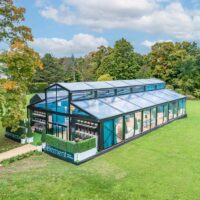
Our offering includes clearspan structure rentals and frame tent rentals that can be installed on a wide range of surfaces and configured to suit your event’s exact requirements.
We approach every project as a custom build – designed around your space, your vision, and how your event needs to function.
We also offer other industrial tent rental options to round out the infrastructure we are building for you, including flooring, health and safety packages, temperature control, power and fencing. Speak to one of our sales reps to explore what you need for your event.
Start by reaching out through our website or directly to our team via the phone number provided on our Contact page. From there, we’ll connect to understand your event, your site, and your priorities.
We don’t take a one-size-fits-all approach. Every tent rental quote is built around a tailored solution, ensuring you get exactly what you need from the outset.
Call us at 1-800-264-4430 or email us at [email protected].
Yes. All of our rental structures and tents are engineered and installed with full consideration for local regulations, permitting requirements, and site-specific conditions.
Our team is experienced in delivering complex builds where safety, compliance, and execution standards are non-negotiable.
Absolutely. Our rental structures are designed as complete environments and can include:
· Solid, clear, or glass wall systems
· Doors and entrance features
· Integrated flooring
· Lighting and power
· Heating or air conditioning
We design each space to ensure comfort, functionality, and a seamless guest experience—regardless of season or setting.
Yes. We work closely with you to create an environment that reflects your brand or event vision.
From layout and flow to interior finishes, furnishings, lighting, drapery, tabletop and décor, every detail can be considered and customized.
Our integrated approach to providing a seamless customer experience makes it easy to coordinate every detail of your event with a single trusted provider. From flooring and furniture rentals to lighting, drapery, tables, and chairs, we help bring every element together for an elegant and professionally executed event experience.
We support a wide range of events, including:
· Weddings and private celebrations
· Corporate events and brand activations
· Festivals and public events
· Sporting events and long-term installations
· Small and large scale parties
Whether it’s an intimate gathering or a high-capacity, multi-day build, our team is equipped to deliver at any size.
We bring together deep industry experience, a national network of resources, and a highly collaborative approach to every project.
Clients choose Element because we:
· Deliver fully integrated event rental solutions
· Manage complex logistics with confidence
· Provide experienced, hands-on project teams
· Maintain a high standard of product quality and execution
Our role is to simplify the process and ensure your event environment is delivered exactly as envisioned.
No two events are the same. Pricing depends on factors like structure type, site conditions, customization, and timing.
By building a tailored quote, we ensure accuracy, and more importantly, that the solution we recommend is the right one for your event.
We support events across Ontario and throughout all of Canada, with the capability to deliver projects across North America when required.
A deposit is required to secure your date and initiate planning. Specific terms vary depending on the scope and scale of the project, and will be outlined clearly during the quoting process.
We recommend reaching out as early as possible, particularly for peak seasons.
For larger or more complex builds, additional lead time allows for proper planning, permitting, and coordination, ensuring a smooth execution.
Yes. We offer a full range of event rentals, allowing you to source everything—from tenting to furnishings and décor—through a single, coordinated partner.
Yes. We provide drapery rentals and interior finishing options to enhance the overall aesthetic and create a polished, cohesive environment within your tent.
Didn’t find your answers?
Contact usTechnical & Safety FAQs
Tents should maintain a minimum clearance from any adjacent structure, permanent or temporary. While exact distances are governed by local fire and building authorities, a general rule is at least 3 metres (10 feet) from any building wall, fence, or combustible structure. This clearance allows for emergency egress, fire suppression access, and structural stability in wind.
Overhead power lines require a minimum 3-metre horizontal clearance for lines up to 750 V, and greater distances for higher-voltage lines, in accordance with provincial electrical codes. Ask your tent rep if you need help determining the line voltage.
Trees introduce two risks: root systems that interfere with staking, and falling limbs during high winds. We recommend keeping a clearance equal to the drip line of any mature tree.
All tent types perform best on level ground. As a practical guide, we can install on grades up to approximately 2% to 3% (a rise of 2–3 cm per metre of run) without significant impact on the structure or client experience. Beyond that, unlevel ground begins to affect leg height adjustments, water runoff toward the tent interior, and the comfort of guests.
If there is a significant slope on the tent area, our team can build a level floor to install the tent on. If you don’t need flooring, we can often manufacture custom tent legs that work with ground height differentials. For a long term tent rental, you may want to consider creating a level area with gravel or concrete for your tent installation.
Ground that is soft, recently disturbed (e.g. freshly landscaped), or waterlogged can also pose problems for staking and overall stability, regardless of slope. Flagging these conditions early allows us to plan alternative anchoring approaches.
Our installation crews arrive with cube trucks and/or flatbed trailers. At a minimum, we require a clear, unobstructed path of at least 3 metres (10 feet) wide and 4.5 metres (15 feet) of overhead clearance to reach the installation site. Any measurements smaller than this may require us to hand carry products to the installation site at an additional fee.
If we cannot bring our trucks up within 50’ of the tent installation site, we may need to charge a fee for extra carrying time.
Weight-bearing capacity is equally important. Paved driveways, landscaped areas, and residential lawns may not support a fully loaded delivery vehicle. If access requires crossing soft ground, covered conduit, or private infrastructure we may need to hand carry product or install ground covering to allow us to drive vehicles close to the installation site.
If there are any access restrictions — security checkpoints, timed delivery windows, shared driveways, or parking lot bollards — please share these details during the planning process. Surprises on installation day can delay setup and affect your event timeline.
Setup timing depends on the size of the structure, any permit or inspection requirements, and your venue’s availability. As a general guideline:
• Small to mid-size tents can typically be installed 1–2 days before the event.
• Large frame or clear-span structures: generally require 2–4 days, depending on size, flooring, and sidewall configuration.
Complex installations with multiple structures could require weeks to install. Work with your tent rep to develop a schedule that works for all parties.
• When a building permit has been issued, an inspection by the local authority should occur before the tent is occupied. Inspection scheduling is outside our control and can take 1–3 business days after the structure is complete. You should take this into consideration during the planning process.
We strongly recommend not scheduling tent-dependent deliveries (furniture, catering, florals) until the tent is confirmed to be fully installed and inspected. Building in a buffer protects your event from unforeseen delays.
Always consider adding in a buffer for weather. If weather is extreme during install and removal it could add time needed.
Our tents are engineered and tested to comply with Canadian structural standards, including applicable requirements under the National Building Code of Canada (NBCC). Commercial-grade event tents, when properly anchored, are generally rated for sustained wind speeds in the range of 80–100 km/h, though specific ratings vary by tent model and size.
It is important to understand that wind load ratings assume correct installation and anchoring. A tent that is staked improperly, or not anchored with the appropriate amount of weight, will not perform to its rated capacity. This is why we take anchoring seriously and will not cut corners on it regardless of aesthetic preferences.
When wind speeds are forecast to approach or exceed the rated threshold, we recommend full evacuation of the tent. A tent in high winds could be a safety hazard. As the renter of the tent, it is your responsibility to develop a plan for inclement weather. See the Weather & Contingency section for specifics on evacuation and monitoring.
This is one of the most important questions for any Canadian event held in shoulder or winter seasons, and it is frequently underestimated.
Standard event tents — including most pole and frame tents — are NOT designed to bear accumulated snow loads. A single significant snowfall can deposit 15–25 kg per square metre on a tent roof, far exceeding the structural capacity of a fabric tensioned over poles or a light aluminum frame. Snow accumulation is the leading cause of tent collapse in Canadian winter events.
Clear-span structures are the appropriate solution for winter or late-fall/early-spring events where snowfall is possible. While most clear-span tents don’t have a snow load, we can modify installation methods and product types to make the structures sturdier. Depending on the tent size, we can offer some smaller clear-span tents with a snow load. Engineered clear-span tents can be specified to meet regional ground snow loads as defined by the NBCC, which vary significantly across Canada — from under 1.0 kPa in parts of southern Ontario to over 4.0 kPa in mountain regions.
For any event between October and April, we will discuss heating strategy as part of your installation plan. A properly heated clear-span structure will melt accumulating snow and prevent dangerous build-up. We do not recommend unheated tents in the winter time.
We offer several anchoring methods, and the right choice depends on your surface, venue restrictions, and aesthetic priorities.
Ground Stakes: The most secure and least visible option. Steel stakes are driven into the ground at the tent’s perimeter anchor points. The stake heads sit flush or slightly above grade and are easy to step over or obscure with décor. This is the default method for any natural-surface installation and the one that best preserves the clean look of the tent. Staking can be done on most ground surfaces (other than concrete). An underground locate is required prior to staking to ensure there are no services under the ground.
Water Ballast Barrels: Used on surfaces where staking is not possible. Barrels are placed at anchor points and filled with water on-site (each barrel weighs approximately 450 lbs when full). They are visible and take up floor space at the tent perimeter. A white vinyl cover can be put on top of the barrel to make it more visually appealing. Water barrels can only be used on structures up to 30’ wide. Draping, signage, or perimeter plantings are commonly used to integrate them into the design.
Concrete Ballast: Used on surfaces where staking is not possible. Concrete ballast, available in a variety of sizes, are placed at anchor points around the perimeter of the tent. A white vinyl cover can be put on top of the ballast to make it more visually appealing. Required amount of ballast is dependent on the tent size, with legs requiring anywhere from 500lbs to 10,000lbs of weight.
Concrete Anchors: For venues with existing concrete or asphalt, sleeve anchors can be drilled and set at permanent or recurring event sites. This produces the cleanest hard-surface anchoring result, but it requires advance coordination, venue permission, and is not reversible. Best suited to venues that host tented events regularly.
Ratchet Straps to Fixed Points: In some situations — particularly where a tent is positioned adjacent to a building, fence, or other robust structure — straps can be used to transfer load to those fixed points. This can reduce or eliminate ground-level anchoring on one or more sides. The visual impact depends on the attachment point and can range from minimal to noticeable.
In many installations, we use a combination of methods. We will always advise on the right approach for your specific site.
Once stakes are removed, they leave small cylindrical holes in the ground, typically 3–5 cm in diameter and between 45–90 cm deep, depending on the stake size used for the tent type. The holes are created by driving the stake, not by drilling, so the surrounding soil is compacted rather than excavated.
On healthy, established turf, visible evidence of staking typically disappears within 2–6 weeks, depending on grass species, soil conditions, time of year, and watering. On summer-dormant or recently seeded turf, recovery may take longer. Staking during frost conditions, or in saturated ground, can cause more visible surface disturbance.
If staking occurs on asphalt, our crew fills the holes with lime stone screening as part of the takedown process.
Hanging capacity is one of the most important technical questions for event design, and the answer varies significantly by tent type. Always confirm hanging loads with us before finalizing your décor or AV plan — overloading a tent structure is a safety risk.
Pole Tents: Load can be applied at the center poles, king poles, and along the ridge line. Practical hanging capacity at a single point is typically in the range of 2lbs, depending on the specific pole and tent size. Distribute loads symmetrically and avoid clustering heavy elements in a single area.
Frame Tents: The aluminum frame provides multiple attachment points across the grid of rafters and purlins. Individual member capacity is generally 10lbs per point, but total load must be distributed evenly across the structure. Frame tents are not suitable for heavy chandelier or truss rigging.
Clear-Span Structures: Engineered rafter systems in clear-span tents can accommodate substantially higher loads, and specific rigging points can often be engineered in during the installation design phase. This is the appropriate tent type for concerts, large productions, and events with significant AV, lighting, or draping requirements. The total hanging capacity is dependent on the tent size and style. Hanging capacity is determined per arch and can range from 250lbs to 2500lbs. When hanging from an arch the weight should be distributed evenly over the arch, with 50% near the peak, and 25% on either side of the peak. Please review the hanging limitations of your specific tent with your tent rep.
Before any stake is driven into the ground, provincial law requires that a utility locate be completed. In Ontario, this is done through Ontario One Call (1-800-400-2255 or ontarioonecall.ca). Other provinces operate equivalent services — Alberta One Call, BC One Call, and similar programs across the country.
Underground infrastructure is far more prevalent than most property owners expect. Gas lines, electrical conduit, water mains, telecommunications cables, and irrigation systems all run below grade — often at shallow depths. A stake driven into a gas line can cause an explosion. Striking an electrical line is potentially fatal. Damaging a utility line can also result in significant repair costs and liability for the property owner.
We can arrange an underground locate for you at a fee. Once marked, the locate remains valid for a defined period (commonly 30 days). The customer is responsible for arranging the locate unless we have made a specific written arrangement otherwise. We will not install stakes on a site without a valid locate on file.
On private property — including residential yards, private parking lots, and event venues — private utilities (lines installed by the property owner) are not captured by the utility locate service. If you have privately installed irrigation, lighting, or secondary electrical running underground these must be marked during the locate process.
Building permit requirements for temporary tents are governed by provincial building codes and local municipal bylaws, which means the threshold varies across Canada. In Ontario, under the Ontario Building Code, tents used for public assembly that exceed 60 m² (approximately 645 sq ft) of floor area, or that are used in conjunction with other structures that together exceed this threshold, require a building permit. Many other provinces use similar thresholds.
Beyond size, other factors that trigger a permit requirement include: intended occupancy (a public event is treated differently than a private gathering on residential property), duration of installation (some jurisdictions distinguish between structures in place for fewer than 14 days versus longer), and proximity to other structures.
When a permit is required, there are typically two options: the client’s venue or event organizer applies directly to the local building department, or we can manage the permit application on your behalf as part of our service (additional fee applies). The permit application requires a site plan, tent specifications, and details about the intended use. Approval timelines vary by municipality — 2–4 weeks is common, but some jurisdictions can move much slower.
We strongly recommend confirming permit requirements as early as possible in your planning process. A permit that takes three weeks to obtain cannot be rushed because your event date is approaching. We can advise on what is typically required in the municipalities we serve, though final determination rests with the local authority.
Tents used for public assembly in Canada are subject to the applicable provincial fire code and, where adopted, requirements derived from NFPA 102 (Standard for Grandstands, Folding and Telescopic Seating, Tents, and Membrane Structures).
Fabric & Flame Resistance: All tent fabric used for public events must meet the flame-resistance requirements of CAN/ULC-S109, the Canadian standard for flame tests of flexible materials. Our tent fabrics are certified to this standard, and documentation is available upon
request. If any additional draping, liners, or décor fabric is being used inside the tent, it must also comply.
Egress: Tents must provide a minimum of two means of egress, located remote from each other, with clear widths based on occupancy load. Egress openings must remain unobstructed at all times during the event. Sidewall panels adjacent to egress points must be clearly identified and openable from the inside without special knowledge or keys. Depending on your tent size, you may need to provide more than two egress points.
Fire Extinguishers: At minimum, one approved ABC-rated portable fire extinguisher must be accessible inside the tent. Additional extinguishers are typically required near cooking equipment, generators, or any open flame. The fire code specifies maximum travel distance to an extinguisher (commonly 25 metres), so larger tents may require multiple units. Fire extinguishers can be rented at an additional fee.
Open Flame & Cooking: Any open flame — candles, fire pits, propane heaters, cooking equipment — must maintain required clearances from tent fabric. Most jurisdictions prohibit certain types of open flame inside tents entirely. Confirm with your local fire authority and with our team before planning fire elements in your event design.
A fire marshal (or fire prevention officer) inspection is typically required in the following circumstances: when a building permit has been issued for the tent, when the tent is used for public assembly above a threshold occupancy, or when the event involves food service, cooking, or open flame inside or directly adjacent to the structure.
Inspections are conducted by the local fire department or municipal fire prevention division, and must be scheduled in advance — they do not happen automatically. When we apply for a permit on your behalf, coordinating the inspection is part of that service. If the client is managing the permit directly, booking the inspection is their responsibility.
The inspection typically covers: tent fabric certification, egress quantity and width, fire extinguisher placement, exit signage (where required), generator and fuel storage placement, and cooking equipment clearances. A failed inspection must be corrected before the tent can be occupied — this is another reason why building in setup lead time is critical.
Even when an inspection is not formally required, we recommend treating the fire code requirements as a baseline for all public events.
Occupancy limits establish the maximum number of people who may be inside a tent at one time. They are calculated based on usable floor area and the intended use of the space, using per-person area factors defined in the applicable building or fire code.
Common benchmarks used in Canadian practice:
• Standing/reception: approximately 0.5–0.65 m² per person
• Seated at round tables (banquet): approximately 1.1–1.4 m² per person
• Theatre / rows of chairs: approximately 0.6–0.75 m² per person
• Seated at rectangular banquet tables: approximately 1.0–1.2 m² per person
The “usable floor area” in these calculations excludes the space taken up by staging, bars, buffet tables, DJ equipment, and any other fixed elements. A tent that appears large on paper can have a significantly lower effective capacity once the floor plan is laid out.
When a building permit is issued, the occupancy load is typically specified on the permit and may need to be posted inside the tent during the event. Exceeding the posted occupancy is a fire code violation. For events that may approach capacity, having a door count in place is recommended.
Under the Ontario Building Code (Table 3.7.4.3.E), tented events classified as assembly occupancies are required to provide a minimum number of water closets based on the number of guests. The calculation assumes an even split between genders, so a tent with 250 guests is treated as 125 persons per gender.
The minimum number of water closets required per gender is:
Up to 50 persons per gender: 2 per gender
51–70: 3 per gender
71–90: 4 per gender
91–110: 5 per gender
111–140: 6 per gender
141–180: 7 per gender
181–220: 8 per gender
221–260: 9 per gender
Over 260: 10, plus 1 for every additional 40 persons per gender above 260
To calculate, halve your total occupancy. An occupancy of 250 = 125 of each gender. This would put you in the 111 – 140 range, and your event would require 6 washrooms per gender.
A common standard for events is providing at least 1 accessible unit for every 20 standard portable units.
Portable washroom trailers and standalone porta-potties both count toward this requirement, provided they are properly serviced and accessible. In permit applications, washroom information often will have to be included as part of the permit process.
It is recommended that you monitor the weather during the rental period of the tent. As a general framework, though specific thresholds vary by tent type and anchoring method, see the following guidelines:
• 50–60 km/h sustained winds: Advisory threshold. Guests should be alert and prepared to modify the event plan.
• 60–80 km/h sustained winds: Closure threshold for most tent types. The tent should be cleared of guests. Open sidewalls should be closed and secured. If all sidewalls cannot be closed we recommend you ensure all side walls are opened. Never leave the tent partially opened or partially closed.
• 80+ km/h or Environment Canada Severe Thunderstorm Warning: Evacuation threshold. Guests must leave the tent and move to a permanent structure. This is a non-negotiable protocol.
It is the event organizer’s responsibility to have a weather contingency plan in place and to communicate it to guests and staff. We can advise on tent-specific thresholds, but on-site decision-making during an event is the organizer’s responsibility. We recommend designating a specific person at each event who is responsible for monitoring conditions and initiating the closure or evacuation protocol.
There are several conditions under which a tent should be evacuated immediately, without waiting for conditions to worsen:
Lightning: If lightning is visible or if the gap between a lightning flash and the sound of thunder is 30 seconds or less (the ‘30-30 rule’), the tent should be evacuated. A tent provides no protection from lightning. Guests should move to a permanent enclosed building and remain there for a minimum of 30 minutes after the last observed lightning or thunder.
Sustained High Winds: As noted above, winds at or above the closure threshold for your tent type require evacuation. Do not wait for visible structural distress — by the time the tent is visibly stressed, conditions have already exceeded safe limits.
Structural Distress: Any visible sign of structural compromise — a leaning pole, a loosened stake, a failing anchor point, or unexpected fabric tension — is grounds for immediate evacuation. Do not attempt to re-anchor or adjust a tent while it is occupied.
Issued Weather Warnings: Any Environment Canada Severe Thunderstorm Warning, Tornado Watch, or Tornado Warning in effect for your area warrants immediate evacuation to a permanent structure. A tent cannot provide meaningful shelter from a tornado or severe convective event.
The evacuation plan should be established before the event begins — specifically, guests and staff should know where the nearest permanent structure is and how to get there quickly. This plan should be communicated to your event staff at the start of every event held under a tent.
Didn’t find your answers?
Contact us
Complete your Tent with Additional Options
Browse our options
What our clients are saying
Follow us on Instagram
The Vista Tent creates a refined, open environment, blending modern design with exceptional versatility.
With options for glass walls, flooring, drapery, and more, the space can be fully customized for any vision.
Aug 19

Connecting every part of the celebration.
Flooring Over Pool creates a beautiful bridge between spaces, expanding the event and taking the experience to another level.
Designed to bring every vision to life.
Aug 12
Built to be customized.
The Legacy Tent combines the height of a frame tent with the clean lines of a clearspan — creating a space that can be shaped to match any vision.
With draping, the look becomes entirely your own.
Where every element works in harmony.
Jul 30
Built for brand moments.
The Q Series Tent is ideal for pop-ups, product launches, and merchandise spaces — offering a customizable setup that adapts to any vision.
Perfect for festivals, activations, and busy event environments. Designed to feel seamless throughout.
Jul 23